
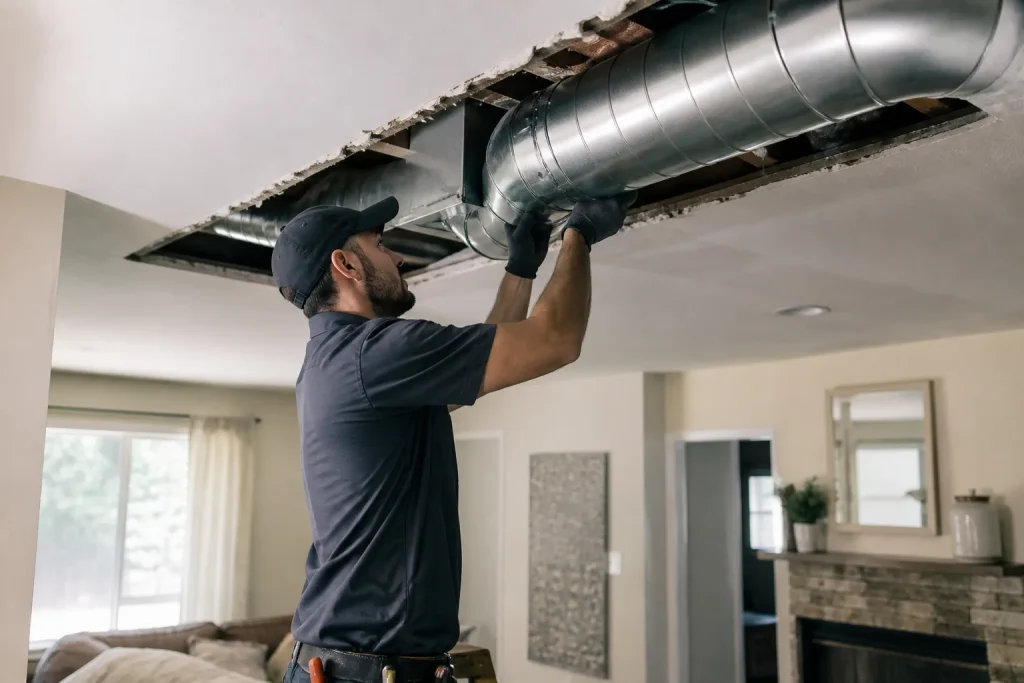
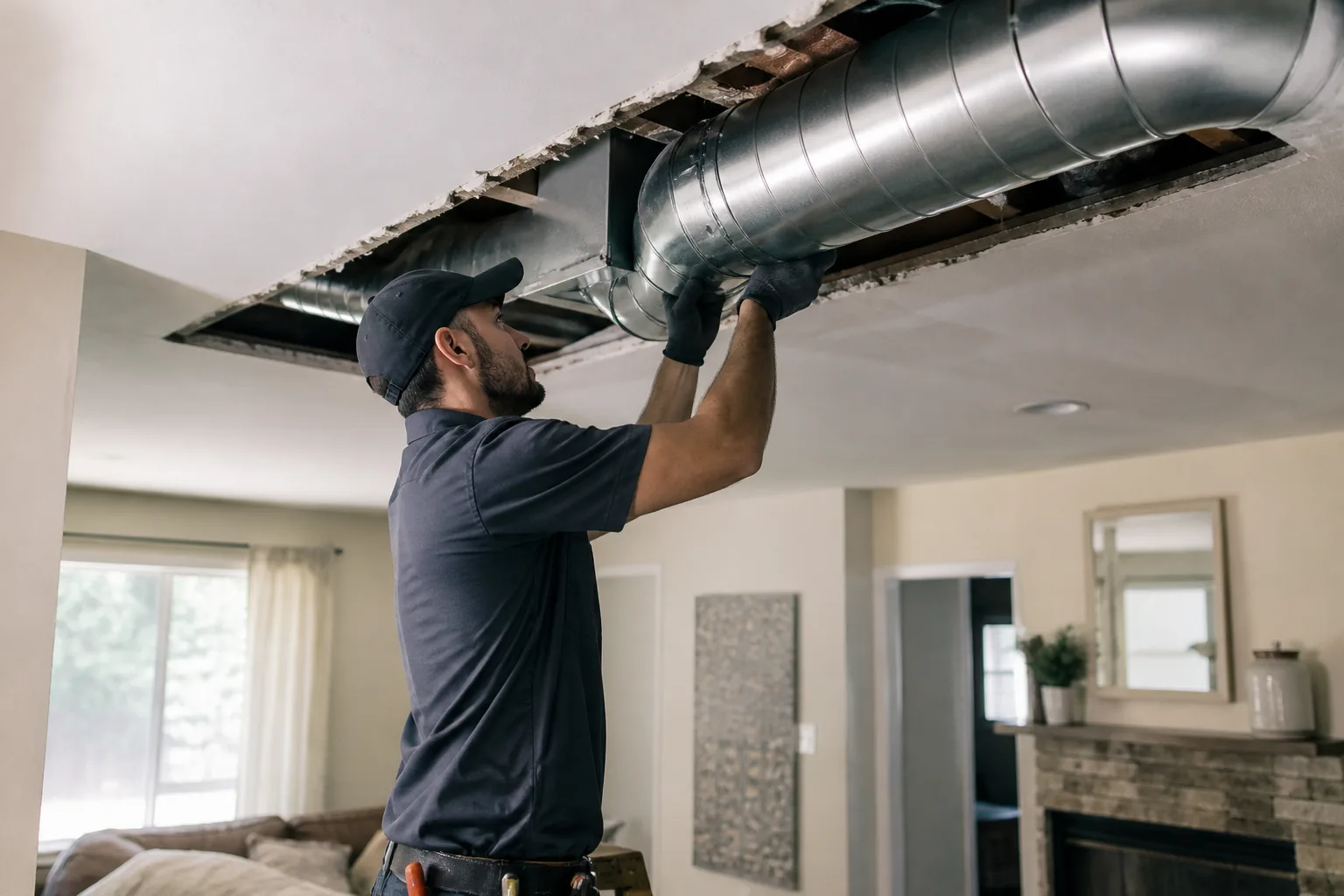
Emergency Air Duct Repair Near Me: What Gresham Homeowners Should Do First
Most duct “emergencies” don’t need a technician at the door within the hour. They need you to stop the damage, confirm the house is safe, and document what failed before anyone touches it. A disconnected boot or a torn flex section can usually be stabilized for the night with materials already in your garage. A collapsed run with no airflow needs a different response. Getting that order right is the whole game. If you’d rather not sort it out yourself, call (844) 523-1942 and we’ll walk you through it.
First: Is It Actually a Duct Problem, or the HVAC Unit?
This is the question that decides everything else, and it’s the one most Gresham homeowners skip. Ducts and equipment fail in different ways, and the wrong diagnosis sends you shopping for the wrong repair. Before you call anyone, watch and listen for a few minutes.
Signs the problem is in the ducts:
- Airflow is weak or absent at one or two registers while the rest of the house feels normal
- You hear whistling, flapping, or a rattle that changes with the blower
- Dust puffs out of a vent when the system starts
- A supply boot is visibly separated from the floor or wall
- You can see torn or sagging flex duct in the attic or crawlspace
Signs the problem is in the equipment:
- No airflow anywhere in the house at once
- The blower runs but nothing comes out of any register
- Ice on the refrigerant lines or a unit that short-cycles
- The system won’t start at all
If it’s the second list, stop here. That’s an HVAC call, not a duct call, and a duct company can’t fix a failed blower. In our experience across Gresham, roughly half the calls that start as “my ducts are broken” turn out to be equipment or thermostat issues. Checking this first saves you a service visit and points you at the right trade.
The Three Most Common Duct Failures and How to Stabilize Each
Most acute failures fall into three categories. Each has a safe temporary measure and a clear point where temporary stops being safe. None of these steps involve climbing into an attic at night or crawling a crawlspace in the dark. If reaching the damaged section means any of that, wait for daylight and call us.
1. A disconnected boot
A supply boot pops loose from the register or the duct run. Air dumps into the attic, wall cavity, or crawlspace instead of your room. The room goes cold, and in an attic you can pull moisture and insulation dust into the living space.
What holds overnight: shut the register or damper for that run so the system isn’t pushing air into unconditioned space. You can also switch the system to fan-only briefly to confirm the rest of the house still moves air, then shut it off. Keep it off overnight if the room is drawing attic air.
What makes it worse: taping the boot back with whatever’s in the junk drawer and running the system hard. Household tape fails within hours, and a partial seal can dump conditioned air into a cavity where it condenses.
2. A torn flex duct section
Rodent damage, a sharp truss edge, or simple age splits the outer jacket and sometimes the inner liner. A small tear means a slow loss of airflow. A large one means the run is effectively open to the attic.
What holds overnight: close the register at the end and leave the run out of the picture until you can get it repaired. A temporary wrap on the outside of a jacket tear, only if it’s easily reachable from a hatch and you can stand safely, will reduce loss. Don’t reach into tight spaces or over your head on a ladder to do it.
What makes it worse: trying to seal the inner liner yourself. That’s not a homeowner repair, and a bad seal will be redone by whoever comes out anyway.
3. A collapsed run
Flex duct that has sagged, crushed, or fully let go from a support. Airflow to that zone drops to near zero. Collapse is usually the result of poor original install or a support failure, not something that happens overnight on its own.
What holds overnight: close the register, run the system on the rest of the house, and expect the system to work a little harder than usual. That’s acceptable for one night. It’s not acceptable for a week.
What makes it worse: running the system wide open into a collapsed section. It strains the blower, and it can push debris back into the run. If you hear the blower laboring, shut the system off.
When a Duct Failure Is an Air Quality or Carbon Monoxide Risk
This is the scenario where you don’t wait for a scheduled visit. A duct failure that pulls attic air, garage air, or combustion byproducts into the living space needs action in the first hour, not the first available appointment.
Call for help immediately, and if anyone in the house has a headache, nausea, dizziness, or unusual fatigue, get everyone outside and call 911. If you have any reason to suspect carbon monoxide, don’t troubleshoot the system yourself. That’s a job for a trained professional, and it starts with the fire department or your gas utility, not a duct company.
Other situations that escalate to “don’t wait”:
- You smell exhaust, fuel, or a strange chemical odor coming from a register
- Visible soot or black staining around any register or the furnace
- A return duct that’s drawing from a garage, attached shop, or basement with a fuel-burning appliance
- Anyone in the home has asthma or a respiratory condition and reports sudden breathing trouble
For these, shut the system off and call. A disconnected return near a gas furnace is a real risk. Most Gresham homes have gas heat, and a return compromised into the wrong space is not the same as a torn supply up in the attic.
Document the Failure Before Anyone Arrives
Good documentation is what separates a fast, accurate repair from a guess. It also protects you when the estimate comes in, because everyone is working from the same picture. We ask for this from Gresham customers because it genuinely shortens the visit.
Photos to take:
- The damaged section, in focus, with something for scale if you can
- Wide shot of the surrounding area, so we can see how the run is supported and where it connects
- The register face and the boot, if the failure is at the register
- The furnace or air handler filter door, showing the filter
- The thermostat setting and any error code on screen
Notes to jot down:
- Which rooms have lost airflow and which are still fine
- Whether the failure happened during a heat cycle, a cool cycle, or at startup
- Any sound you hear, in plain words (“flapping”, “whistling on the left side”)
- Whether the filter was recently changed and whether the problem started after
You don’t need to climb anything to get this. Photos from the hatch or from a phone held up to the register are enough. Don’t go into an attic at night, on a ladder, or across loose insulation to get a better angle.
How to Filter Out the Wrong Emergency Responder Fast
The industry’s weak spot is the phone call. A responder who can’t answer three questions clearly is going to be a temporary fix. Here’s what to ask before you book anyone.
- “What equipment do you carry?” A real duct repair call should be staffed for both cleaning and repair. We use professional-grade systems from Rotobrush and Nikro, and we carry what’s needed to make a permanent repair, not just a patch. A crew with only a shop vac is a cleaning crew, not a repair crew.
- “Can you make a permanent repair today, or am I getting a temporary patch?” You want a clear answer. A temporary patch is fine as a stopgap, but it should be labeled as one.
- “What’s in the written scope?” It should name the failure, the repair, the materials, and the price. If you’re getting a range and a promise of a quote later, that’s the setup for a surprise.
- “Is the estimate written?” One flat price per system, agreed before work starts. That’s how it should work.
If the person on the phone can’t describe the failure you’re seeing, or can’t tell you what equipment will show up, keep dialing. Duct repair isn’t complicated, but it isn’t generalized either. Our technicians have up to 15 years of experience, and that’s the level of specificity you should expect from any company you call.
When to Call a Pro, and When You Can Wait for Morning
Most of what we described here is safe to sit overnight if the system is shut off and the run is closed. The exceptions are the ones we named: any carbon monoxide concern, any smell of exhaust or fuel, any soot, anyone in the home with sudden breathing trouble, or a blower that’s laboring with the system running. Those are the calls that shouldn’t wait.
The rest can wait for a scheduled visit. A disconnected boot, a torn flex section, or a collapsed run closed off at the register isn’t going to get worse overnight as long as the system isn’t pushing air into it. Getting a repair done right the first time beats a temporary fix you pay for twice.
Related services in Gresham: if the failure turns out to be dust and debris built up in the runs rather than damage, air duct cleaning handles that. If you’re not sure which service applies, we can sort it out on the call.
If you want the full picture of what we do, start with Duct Cleaning Gresham. If you’re a homeowner in Gresham and want to line up the rest of the system, we also handle dryer vent cleaning on the same visit.
The Bottom Line
Most duct failures in Gresham are stabilizable in the first hour. Shut the affected run, document the failure with photos, and confirm the problem is in the ducts and not the equipment. If you smell fuel or exhaust, see soot, or anyone in the house feels off, call immediately. Otherwise, get a proper estimate from a company that can make a permanent repair.
Our repairs aren’t just cleaning with a wrench. We use professional-grade equipment from brands like Aprilaire and Abatement Technologies where filtration and air quality are part of the fix, and we make the repair permanent in the same visit. Every job is one flat price per system, agreed before work starts, with before-and-after photos so you can see the difference.
If you’re in Gresham and need help, Duct Cleaning Gresham offers free estimates – call (844) 523-1942. We answer 24/7. Fast dispatch from 7am to 7pm, Sunday through Friday.
Frequently Asked Questions
Close the register at that run and shut the system off if the blower sounds strained. Don’t go into the attic or crawlspace to inspect it at night. Take a phone photo from the hatch if you can safely, then call for a scheduled repair. Call (844) 523-1942 for a free estimate – we answer 24/7.
No, but it can become one. A return duct compromised near a fuel-burning appliance, or soot or fuel smells at any register, put it in that category. If that’s what you’re seeing, shut the system off, get everyone outside, and call 911 if anyone feels unwell. Don’t try to fix it yourself.
Sometimes, but it isn’t the plan. A patch slows the damage. It doesn’t fix the cause. The right timing is to close the run, keep the system off that section, and get a proper repair. A permanent repair today beats a temporary patch you’ll redo. Call (844) 523-1942 – estimates are free.
You get a written scope before work starts and before-and-after photos of your ducts when it’s done. We also recommend walking through the failure with the technician so you understand what changed. If something doesn’t look right, say so before they leave. That’s the standard. For an exact quote, call (844) 523-1942.
Written by the team at Duct Cleaning Gresham.
Need Air Duct Cleaning Help?
Call Duct Cleaning Gresham - licensed & insured, here with fast help in Gresham.
(844) 523-1942